Air Purifier vs Dehumidifier for Mold: Which One Do You Actually Need in 2025?
Mold spores exist in virtually every home, but they only become a problem when moisture levels exceed 60%. The EPA reports that maintaining indoor humidity between 30-50% prevents most mold growth entirely. This guide breaks down exactly when you need a dehumidifier, an air purifier, or both to protect your home.
How Dehumidifiers Prevent Mold Growth
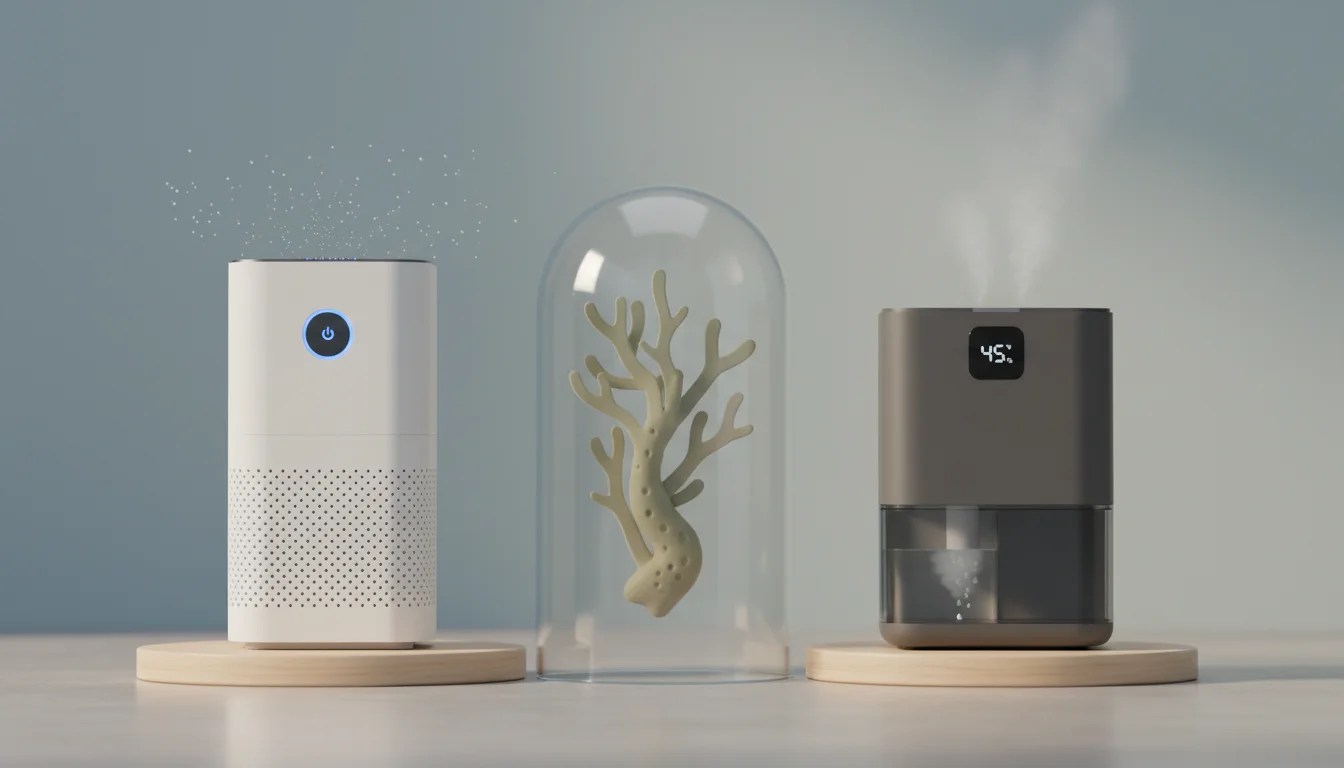
Dehumidifiers attack mold at its source by pulling excess moisture from the air and maintaining humidity below the 60% threshold where mold thrives. They work by drawing humid air over cold coils, condensing water into a collection tank, and releasing drier air back into your space.
| Feature | Refrigerant Dehumidifier | Desiccant Dehumidifier |
|---|---|---|
| Best Climate | Warm, humid (70°F+) | Cool environments (below 65°F) |
| Mechanism | Condenses moisture on cold coils | Absorbs moisture with silica gel |
| Energy Use | Higher in cool temps | Consistent across temperatures |
| Noise Level | Moderate (compressor) | Quieter operation |
| Best For | Basements, summer use | Garages, unheated spaces |
For capacity, match your unit to your space. A 30-pint-per-day unit covers roughly 1,000 square feet in moderately damp conditions. Wetter environments need 50+ pints daily. I learned this the hard way after undersizing my first basement unit—it ran constantly without ever hitting target humidity.
Your dehumidifier needs regular maintenance. Empty the tank daily or connect a drain hose for continuous operation. Clean the coils monthly to prevent mold growth inside the unit itself. Angi notes that dehumidifiers prevent new mold but cannot kill existing colonies.
How Air Purifiers Remove Mold Spores
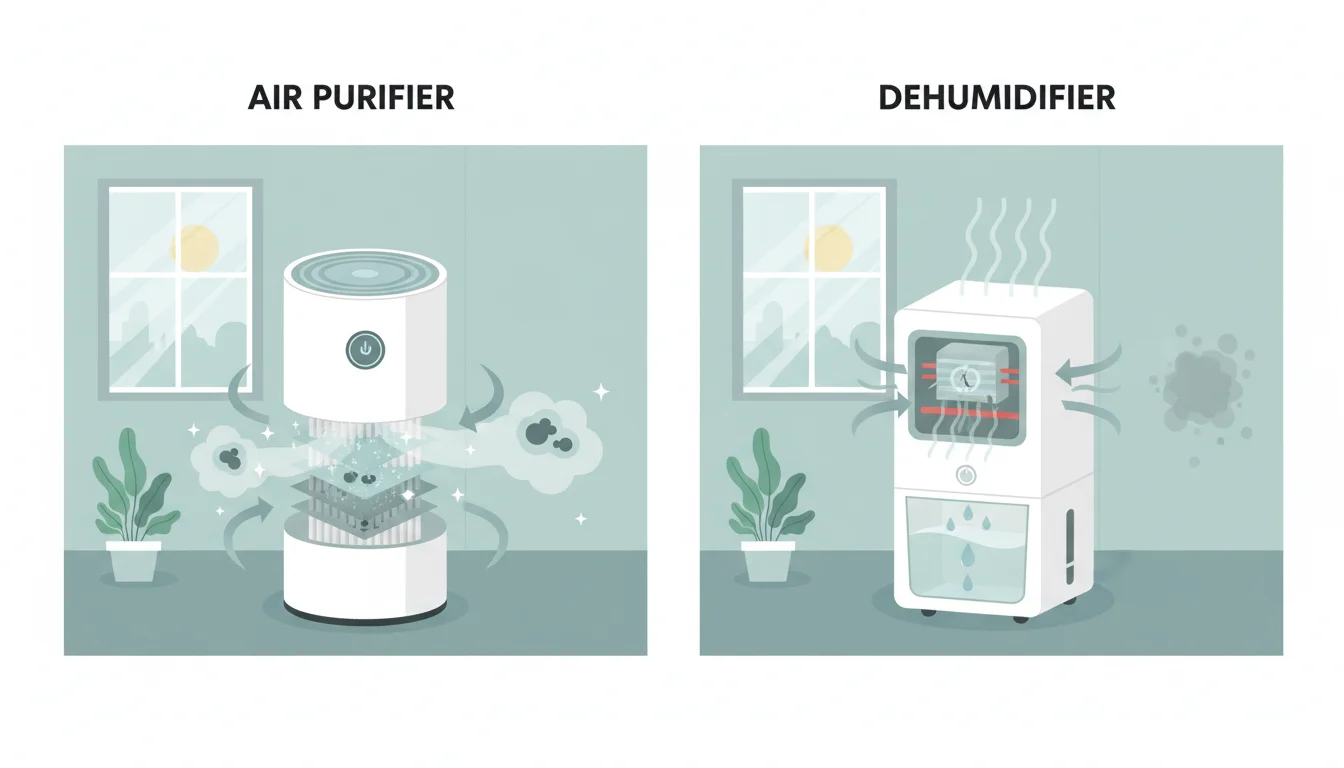
HEPA air purifiers capture mold spores ranging from 1-30 microns as air passes through dense filter media, removing up to 99.97% of airborne particles. They clean the air you breathe but do nothing to stop mold from growing on surfaces.
- HEPA filters trap spores mechanically and need replacement every 6-12 months
- UV-C light models neutralize captured spores, preventing reproduction inside the unit
- Activated carbon filters eliminate musty odors but don't capture spores themselves
- CADR ratings indicate cleaning speed—aim for a CADR of at least 2/3 your room's square footage
- Ionizers charge particles to fall from the air, but spores land on surfaces rather than being removed
Air purifiers shine during active mold exposure. If you're experiencing allergies or respiratory symptoms from mold, a purifier provides faster relief than a dehumidifier. Oransi explains that purifiers manage symptoms while dehumidifiers address root causes.
The catch? Running an air purifier in a humid room is like mopping while the faucet runs. You'll capture today's spores while new ones form overnight.
Key Differences: Root Cause Prevention vs Active Removal
The air purifier vs dehumidifier for mold debate comes down to prevention versus treatment. Dehumidifiers stop mold before it starts. Air purifiers clean up spores already floating in your space.
| Factor | Dehumidifier | Air Purifier |
|---|---|---|
| Primary Function | Removes moisture | Removes airborne particles |
| Mold Prevention | Yes, addresses root cause | No, only captures existing spores |
| Immediate Relief | No | Yes, cleans air within hours |
| Energy Cost | $15-30/month typical | $5-15/month typical |
| Maintenance | Empty tank, clean coils | Replace filters ($30-100/year) |
| Noise | Moderate to loud | Quiet to moderate |
| Effective Range | Whole room/floor | Single room only |
Think of it this way: a dehumidifier is like fixing a leaky roof, while an air purifier is like putting buckets under the drips. Both help, but one solves the problem permanently.
Operating costs favor air purifiers in the short term, but dehumidifiers save money over time by preventing costly remediation. Professional mold removal runs $1,500-5,000 for moderate infestations. A quality dehumidifier costs $200-400 upfront. UseFarsight calls dehumidifiers the first line of defense for exactly this reason.
When to Choose a Dehumidifier
A dehumidifier becomes essential when your home's moisture levels consistently exceed 50%, especially in enclosed spaces with limited airflow. Basements, bathrooms without exhaust fans, and laundry rooms are prime candidates.
- Condensation on windows signals humidity above 60%
- Musty odors indicate active mold growth somewhere in the space
- Water stains on walls or ceilings mean chronic moisture problems
- Peeling paint or wallpaper suggests trapped moisture in walls
- Humid climates like the Southeast or coastal regions where outdoor humidity stays high
I keep a $15 hygrometer in my basement. It paid for itself the first month by revealing humidity spiking to 72% after rain. Without that data, I would have assumed my space was fine.
If you live in Houston, Miami, or anywhere with summer humidity above 70%, a dehumidifier isn't optional—it's required equipment for mold prevention. HisoAir recommends dehumidifiers as the primary tool for humid climate homes.
When to Choose an Air Purifier
An air purifier makes sense when you need immediate relief from airborne mold spores, particularly if you're experiencing allergy symptoms or respiratory irritation. It's the right tool when you can't control the moisture source.
- Renters who lack permission to modify HVAC or address structural moisture
- During mold remediation when professionals stir up dormant spores
- Allergy sufferers who react to mold spores even at low concentrations
- After flooding when spore counts spike before full drying occurs
- Older homes with hidden mold behind walls that can't be immediately addressed
Fair warning: an air purifier without moisture control is a temporary fix. You'll need to run it continuously, replace filters regularly, and accept that new spores form daily.
For bedroom use, air purifiers excel. Running one overnight reduces the spore count you breathe during sleep—this matters significantly if mold triggers your asthma or allergies. TheDryAir suggests air purifiers for symptom management alongside dehumidifiers for prevention.
Why You Might Need Both Devices
The most effective mold control strategy combines both devices. A dehumidifier prevents new growth while an air purifier removes spores already circulating. Neither alone provides complete protection.
| Scenario | Dehumidifier Alone | Air Purifier Alone | Both Devices |
|---|---|---|---|
| Prevent new mold | Effective | Ineffective | Effective |
| Remove existing spores | Ineffective | Effective | Effective |
| Reduce allergies | Slow improvement | Fast improvement | Fast improvement |
| Long-term cost | Moderate | Lower | Higher upfront, lowest long-term |
| Post-remediation | Essential | Helpful | Ideal |
After my basement flooded, I ran both devices for three months. The dehumidifier brought humidity from 78% down to 45%. The air purifier caught spores released as materials dried. Air quality tests afterward showed normal spore counts.
Combo units exist but typically underperform. A $400 combo rarely matches a $200 dehumidifier paired with a $150 air purifier. Separate units let you size each device for your specific needs and replace one independently if it fails. [Airdog USA] recommends dedicated devices over combination units for serious mold concerns.
Making the Right Choice for Your Home
Start with data before buying either device. A hygrometer reading above 50% means a dehumidifier comes first. Visible mold or allergy symptoms mean an air purifier provides faster relief.
- Step 1: Measure humidity in problem areas for 3-7 days
- Step 2: Check for visible mold, condensation, or musty smells
- Step 3: Consider your climate zone and seasonal humidity patterns
- Step 4: Calculate room size for proper device capacity
- Step 5: Budget for ongoing costs including filters and electricity
Room size matters more than brand names. An undersized unit runs constantly without reaching target levels. Oversizing wastes money upfront. Match capacity to your actual square footage and moisture load.
For most homes with mold concerns, buy a dehumidifier first. Add an air purifier if symptoms persist or if you want cleaner air beyond mold control. Intellipure suggests this staged approach to balance effectiveness with budget.
FAQ
Do air purifiers kill mold or only capture spores?
Standard HEPA air purifiers capture mold spores but don't kill them. UV-C equipped models can neutralize captured spores, preventing them from reproducing if they escape the filter.
What humidity level kills existing mold?
Mold doesn't die from low humidity alone. It goes dormant below 60% and stops producing new spores. Killing existing mold requires cleaning, remediation, or treatment with antimicrobial solutions.
How long should I run a dehumidifier for mold prevention?
Run your dehumidifier continuously until humidity stays below 50% for 24-48 hours. In humid climates, this often means running it year-round during warm months.
Can mold grow inside my dehumidifier?
Yes. Standing water in the collection tank and moisture on coils create ideal mold conditions. Empty the tank daily and clean coils monthly to prevent this common problem.
Are whole-house dehumidifiers better than portable units?
Whole-house units integrated with HVAC systems provide consistent humidity control throughout your home. They cost $1,500-3,000 installed but eliminate the need for multiple portable units.
What CADR rating do I need for mold spores?
Choose an air purifier with a CADR at least 2/3 of your room's square footage. For a 300-square-foot bedroom, aim for 200+ CADR. Higher ratings clean air faster.
Do I need special filters for mold in my air purifier?
True HEPA filters capture mold spores effectively. Adding an activated carbon filter helps with musty odors. Avoid ionic or ozone generators as primary mold solutions.
How quickly do dehumidifiers reduce humidity?
Most dehumidifiers drop humidity 5-10% within 24 hours in properly sized spaces. Reaching target levels of 30-50% takes 2-5 days depending on initial moisture load and unit capacity.
Share this post
Related Posts
UV Air Purifier for HVAC: Complete 2025 Guide to Cleaner Indoor Air
UV Air Purifier for HVAC: Complete 2025 Guide to Cleaner Indoor Air
Air Purifier With Window Open: Does It Work? (2025 Guide)
Air Purifier With Window Open: Does It Work? (2025 Guide)
Air Purifiers for Cigarette Smoke: What Actually Works (2025 Guide)
Air Purifiers for Cigarette Smoke: What Actually Works (2025 Guide)