Air Purifiers for Cigarette Smoke: What Actually Works (2025 Guide)
Cigarette smoke contains over 7,000 chemicals, including particulate matter and volatile organic compounds that standard filters struggle to capture. Studies show air purifiers designed for cigarette smoke with HEPA filters reduce indoor PM2.5 levels by 50-80%, though gaseous pollutants like nicotine often remain. This guide covers filter technologies, top-rated models, real-world effectiveness, and total cost of ownership.
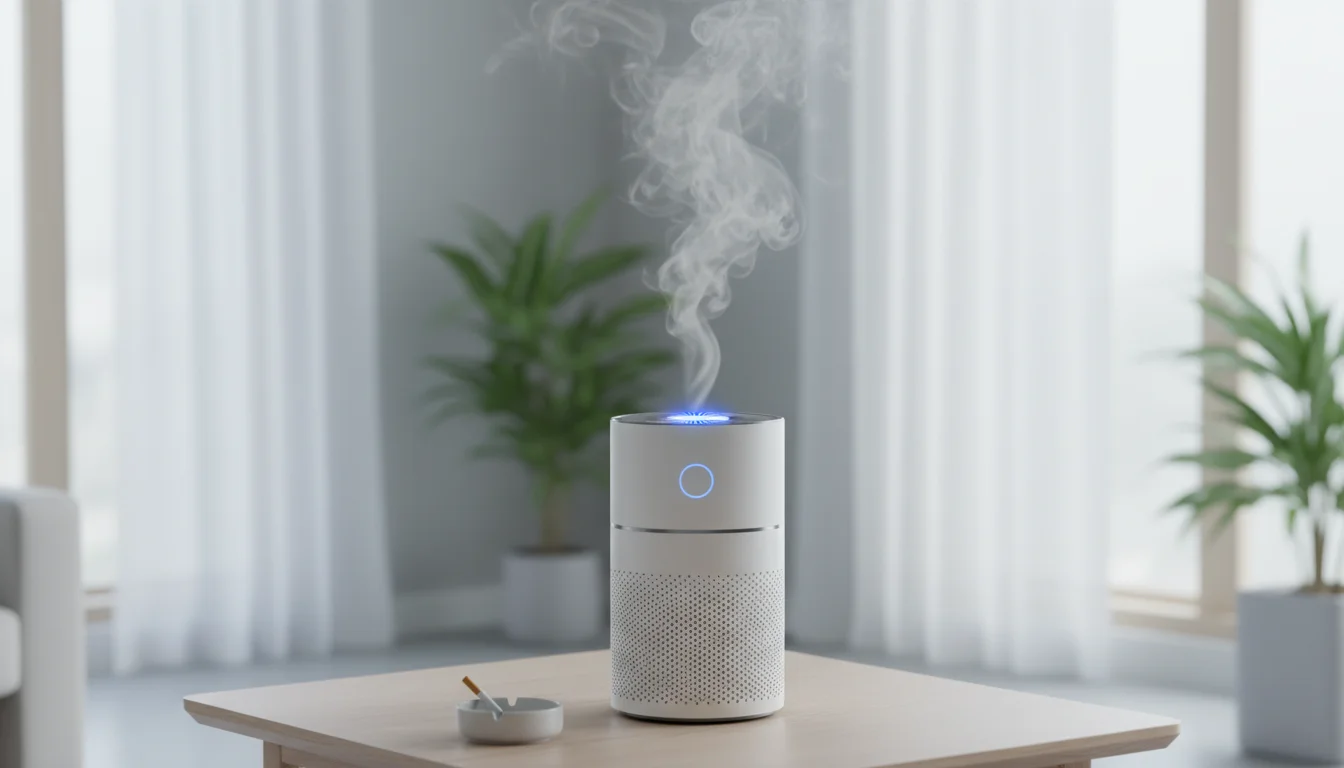
Why Cigarette Smoke Is Harder to Remove Than Regular Air Pollutants
Tobacco smoke particles measure between 0.1 and 1 micron, making them 50 to 1,000 times smaller than common household dust. This microscopic size allows smoke to remain suspended in air for hours and penetrate deep into lung tissue.
The challenge extends beyond particle size. Cigarette smoke contains both solid particulates and gaseous pollutants, creating a dual filtration problem that most air purifiers fail to solve.
| Pollutant Type | Size Range | Standard HEPA Effectiveness | Requires |
|---|---|---|---|
| Dust/Pollen | 5-100 microns | 99.97% capture | HEPA only |
| Cigarette smoke particles | 0.1-1 micron | 99.97% capture | HEPA only |
| Smoke VOCs (formaldehyde, benzene) | Gaseous | 0% removal | Activated carbon |
| Nicotine | Gaseous | 0% removal | Activated carbon |
| Tar residue | 0.1+ microns | Partial capture | Pre-filter + HEPA |
Thirdhand smoke adds another layer of difficulty. Tar and nicotine residue settle on walls, furniture, and fabrics, continuously releasing toxins back into the air for months. A secondhand smoke air purifier handles airborne particles, but surface contamination requires physical cleaning.
The health stakes are significant. Secondhand smoke exposure causes respiratory infections, cardiovascular disease, and lung cancer in nonsmokers. Children exposed to cigarette smoke particles face higher rates of asthma, ear infections, and sudden infant death syndrome. U.S. Surgeon General
HEPA vs Activated Carbon: Which Filter Technology Works Best
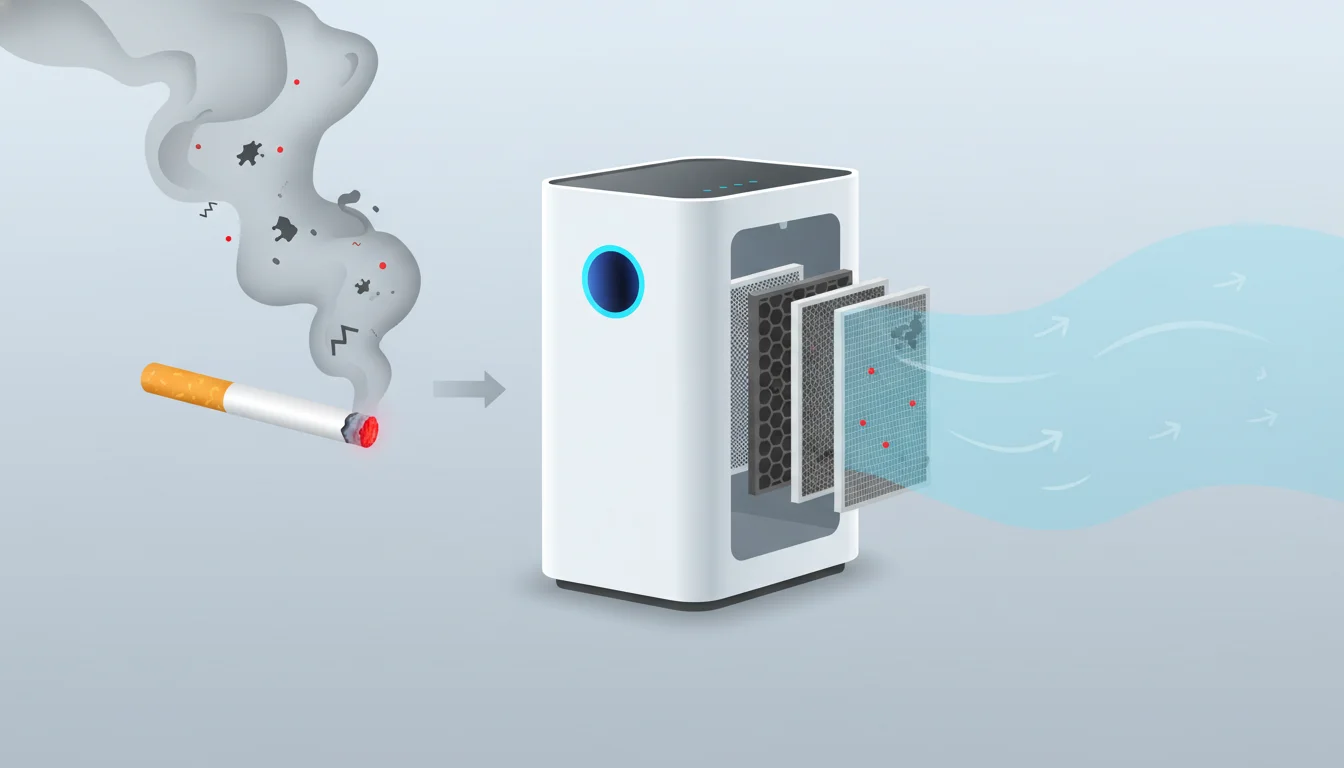
You need both technologies working together. HEPA captures visible smoke and particulates, while activated carbon removes the gases and odors that HEPA completely misses.
True HEPA filters trap 99.97% of particles down to 0.3 microns through mechanical filtration. This includes smoke ash, tar particles, and the visible haze from cigarettes. The limitation is straightforward: HEPA does nothing for smoke smell or chemical vapors.
Activated carbon works through adsorption, a process where gas molecules chemically bond to the carbon surface. This eliminates smoke odors and captures VOCs like formaldehyde and benzene that pose serious health risks.
| Filter Type | Captures Particles | Removes Odors | Removes VOCs | Lifespan in Smoke Environment |
|---|---|---|---|---|
| True HEPA | Yes (99.97% at 0.3μm) | No | No | 6-12 months |
| Thin carbon pre-filter | No | Minimal | Minimal | 1-2 months |
| Heavy activated carbon (5+ lbs) | No | Yes | Yes | 3-6 months |
| HEPA + Heavy carbon combo | Yes | Yes | Yes | Varies by filter |
Carbon weight matters enormously. Thin carbon pre-filters in budget purifiers weigh mere ounces and saturate within weeks in smoky environments. Serious smoke-removal models pack 5 to 15 pounds of activated carbon. That extra weight translates directly to odor absorption capacity and filter longevity. Oransi
Medical-grade units add specialized stages for tar and chemical removal. These multi-stage systems cost more upfront but deliver the most thorough smoke cleanup for heavy smokers.
Key Features to Look for in a Smoke Air Purifier
Match your room size to a unit rated for 1.5 times your actual square footage. Smoke requires faster air processing than standard allergens, and oversizing ensures adequate air changes per hour.
The CADR smoke rating tells you how quickly a purifier cleans smoke from a standardized room. Aim for 200+ CADR for average rooms and 300+ for larger spaces or heavy smoking. This number matters more than marketing claims.
| Feature | Minimum for Light Smoke | Recommended for Heavy Smokers | Why It Matters |
|---|---|---|---|
| Room coverage | Actual room size | 1.5x room size | Ensures adequate air changes |
| Smoke CADR | 150+ | 250+ | Measures actual smoke removal speed |
| Carbon filter weight | 2-3 lbs | 5-15 lbs | Determines odor absorption capacity |
| Air changes per hour | 4 ACH | 6+ ACH | Complete room cleaning frequency |
| Noise level (medium) | Under 55 dB | Under 50 dB | Livability for continuous use |
| Pre-filter | Washable | Dedicated tar pre-filter | Extends HEPA life, traps sticky residue |
Carbon filter quality separates effective smoke purifiers from decorative appliances. An air purifier for heavy smokers needs substantial carbon weight. Check the manufacturer specs, not the marketing copy.
Pre-filters deserve attention in smoke environments. Tar creates sticky residue that clogs HEPA filters faster than dry particulates. A dedicated pre-filter stage catches this residue first, extending your expensive HEPA filter's useful life by months.
Noise becomes critical for bedrooms and living spaces. Units running continuously at 60+ decibels create fatigue. Look for models under 50 dB on medium settings. You'll appreciate the difference at 2 AM when the purifier hums quietly instead of roaring.
Top Air Purifier Recommendations for Cigarette Smoke (2025)
Specialized smoke purifiers with deep-bed carbon outperform mainstream models by a significant margin. The difference between adequate and excellent comes down to carbon weight and filtration stages.
| Model | Room Coverage | Carbon Weight | Smoke CADR | Noise (Max) | Price Range | Best For |
|---|---|---|---|---|---|---|
| Austin Air HealthMate Plus | 1,500 sq ft | 15 lbs | 400 | 55 dB | $700-800 | Heavy smokers, whole-home |
| AllerAir AirMedic Pro 5 | 1,000 sq ft | 18 lbs | 350 | 52 dB | $900-1,100 | Medical-grade smoke removal |
| IQAir GC MultiGas | 1,125 sq ft | 12 lbs | 300 | 49 dB | $1,200-1,400 | Chemical sensitivity, premium |
| Coway Airmega 400 | 1,560 sq ft | 2 lbs | 350 | 52 dB | $500-600 | Light smoke, budget-conscious |
| Winix 5500-2 | 360 sq ft | 1 lb | 243 | 56 dB | $150-200 | Small rooms, occasional smoke |
Austin Air and AllerAir dominate for serious cigarette smoke removal. Their heavy carbon loads handle persistent smoke odors that mainstream options miss entirely. The HealthMate Plus runs continuously for years with minimal maintenance.
IQAir's GC MultiGas targets chemical sensitivity and VOC removal. The price stings, but the German engineering delivers measurable results for those who need medical-grade air quality.
Mainstream options like Coway and Winix work for light smoke or occasional exposure. Their thin carbon filters saturate quickly in heavy smoke environments. Be aware that you'll replace filters every 6-8 weeks instead of every 6 months.
Renters benefit from portable units that move between rooms. Homeowners should consider permanent solutions or multiple units for whole-home coverage. Smart features and app controls add convenience but don't improve actual filtration performance. Smarter HEPA
Total Cost of Ownership: Filter Replacement and Maintenance
Annual filter costs often exceed the original purchase price. A $200 purifier requiring $150 yearly in filters costs more over five years than a $600 unit with $100 annual filter expenses.
Smoke destroys filters faster than clean-air use. Expect to replace carbon filters every 3-6 months instead of the standard 12-month recommendation. HEPA filters last 12-18 months under normal conditions but degrade to 8-12 months in smoke-heavy homes.
| Model | Initial Cost | Annual Filter Cost | 3-Year Total | 5-Year Total | Monthly Electricity |
|---|---|---|---|---|---|
| Austin Air HealthMate Plus | $750 | $200 | $1,350 | $1,750 | $8-12 |
| AllerAir AirMedic Pro 5 | $1,000 | $250 | $1,750 | $2,250 | $10-15 |
| IQAir GC MultiGas | $1,300 | $350 | $2,350 | $3,050 | $8-10 |
| Coway Airmega 400 | $550 | $120 | $910 | $1,150 | $5-8 |
| Winix 5500-2 | $175 | $80 (smoke use: $160) | $655 | $975 | $4-6 |
Pre-filters save money over time. Washing or replacing a $20 pre-filter monthly protects your $80 HEPA filter from premature clogging. This simple maintenance step extends HEPA life by 30-50%.
Several brands offer subscription discounts on replacement filters. Austin Air and Coway both provide 10-15% savings through auto-ship programs. Calculate whether subscriptions make sense based on your replacement frequency.
Running costs add $5-15 monthly depending on wattage and local electricity rates. Units running 24/7 consume 50-100 kWh monthly. This steady cost compounds over years of ownership. PMC Study on Air Purifier Effectiveness
Maximizing Effectiveness: Complementary Smoke Reduction Strategies
Air purifiers work best as part of a comprehensive approach. Relying solely on filtration while ignoring ventilation and cleaning limits your results.
| Strategy | Effectiveness | Cost | Effort Level |
|---|---|---|---|
| Smoke outdoors or near open windows | Highest impact | Free | Low |
| Run exhaust fans during/after smoking | High impact | Minimal | Low |
| Open windows for cross-ventilation | High impact | Free | Low |
| Deep clean surfaces monthly | Medium impact | $20-50/month | Medium |
| Wash fabrics exposed to smoke | Medium impact | Minimal | Medium |
| Position purifier near smoke source | Medium impact | Free | Low |
| Clean HVAC filters monthly | Low-medium impact | $10-30/month | Low |
Placement affects performance dramatically. Position your purifier 3-6 feet from the smoke source with clear airflow around all sides. Tucking a unit into a corner reduces intake efficiency by 30-40%.
Designating smoking areas near windows creates a natural ventilation path. Smoke travels toward the open window instead of dispersing throughout your home. Pair this with an exhaust fan for significant smoke reduction before your purifier even engages.
Regular cleaning attacks thirdhand smoke that purifiers cannot reach. Wipe hard surfaces with damp cloths weekly. Wash curtains, bedding, and upholstery monthly. Vacuum with HEPA-equipped machines to avoid redistributing settled particles. EPA Air Research
A note about ionizers and UV-C: these supplementary technologies add cost without proportional benefit for smoke removal. Ionizers create ozone as a byproduct, and UV-C works too slowly on airborne particles. Stick with proven HEPA and carbon combinations.
FAQ
Do air purifiers completely eliminate cigarette smoke smell?
Heavy-duty activated carbon filters remove most smoke odor from circulating air. Complete elimination requires 5+ pounds of carbon and regular filter replacement every 3-6 months in smoking environments.
How long does an air purifier take to clear a room of cigarette smoke?
Units with 200+ smoke CADR clear average-sized rooms in 15-30 minutes. Larger rooms or heavier smoke concentrations require 45-60 minutes. Running continuously prevents buildup.
Can a cheap air purifier work for cigarette smoke?
Budget models under $100 capture smoke particles but fail at odor removal. Their thin carbon filters saturate within weeks. Expect frequent filter replacements that offset the lower purchase price.
Should I run my air purifier 24/7 for cigarette smoke?
Continuous operation provides the best results in smoke environments. Thirdhand smoke releases constantly from surfaces, requiring ongoing filtration. Use lower fan speeds overnight to balance noise and effectiveness.
Where should I place an air purifier for cigarette smoke?
Position the unit 3-6 feet from where smoking occurs with 2 feet of clearance on all sides. Avoid corners and blocked areas. Elevating the unit 2-3 feet off the floor improves intake of rising smoke.
Do HEPA air purifiers remove nicotine from the air?
HEPA filters capture nicotine attached to particles but miss gaseous nicotine vapor. Activated carbon filters adsorb gaseous nicotine. Combined HEPA and heavy carbon filtration addresses both forms.
How often should I replace filters in a smoky environment?
Replace carbon filters every 3-6 months and HEPA filters every 8-12 months when filtering cigarette smoke. Pre-filters need monthly washing or replacement. Monitor for decreased airflow or returning odors as replacement indicators.
Share this post
Related Posts
UV Air Purifier for HVAC: Complete 2025 Guide to Cleaner Indoor Air
UV Air Purifier for HVAC: Complete 2025 Guide to Cleaner Indoor Air
Air Purifier With Window Open: Does It Work? (2025 Guide)
Air Purifier With Window Open: Does It Work? (2025 Guide)
Air Purifier Ionizers: Good or Bad? The Science-Backed Verdict for 2025
Air Purifier Ionizers: Good or Bad? The Science-Backed Verdict for 2025