Best Air Purifiers That Remove VOCs: Complete 2025 Buying Guide
Volatile organic compounds are invisible gases that off-gas from furniture, paint, cleaning products, and building materials throughout your home. EPA studies show indoor VOC levels run 2–5 times higher than outdoor concentrations. This guide covers which technologies actually work for VOC removal and how to calculate the true cost of ownership before you buy.
What Are VOCs and Why Are They Dangerous?
Volatile organic compounds are gaseous chemicals—including formaldehyde, benzene, toluene, and acetaldehyde—that exist at room temperature as invisible vapors you breathe constantly indoors.
These compounds enter your home from sources you interact with daily:
- New furniture and mattresses release formaldehyde from adhesives and foam
- Fresh paint and finishes off-gas for weeks or months after application
- Carpets and flooring emit chemicals from backing materials and dyes
- Cleaning supplies and air fresheners contain synthetic fragrances that are themselves VOCs
- Pressed wood products like cabinets and shelving use formaldehyde-based resins
Health impacts range from immediate to long-term. Short-term exposure causes headaches, eye irritation, and respiratory discomfort. Prolonged exposure to certain compounds like benzene and formaldehyde carries documented cancer risk.
Your indoor air quality suffers most in newer or recently renovated homes. Tight building envelopes trap these gases inside while limiting fresh air exchange.
How Air Purifiers Remove VOCs: Technology Comparison
An air purifier that removes VOCs uses activated carbon adsorption, specialized oxidation technology, or mineral-based filtration to capture or destroy gas molecules that standard HEPA filters miss entirely.
| Technology | How It Works | Best For | Limitations |
|---|---|---|---|
| Activated Carbon | Porous carbon traps VOC molecules on surface | Most common VOCs, odors | Requires replacement when saturated |
| PECO (Molekule) | Light-activated catalyst destroys molecules | Continuous destruction | Higher cost, complex mechanism |
| Zeolite Filters | Microporous minerals adsorb specific chemicals | Ammonia, nitrogen compounds | Narrow chemical targeting |
| Catalytic Oxidation | Heat converts VOCs to CO2 and water | Industrial applications | Requires high temperatures |
| HEPA Alone | Captures particles 0.3 microns and larger | Dust, pollen, smoke particles | VOC gases pass through completely |
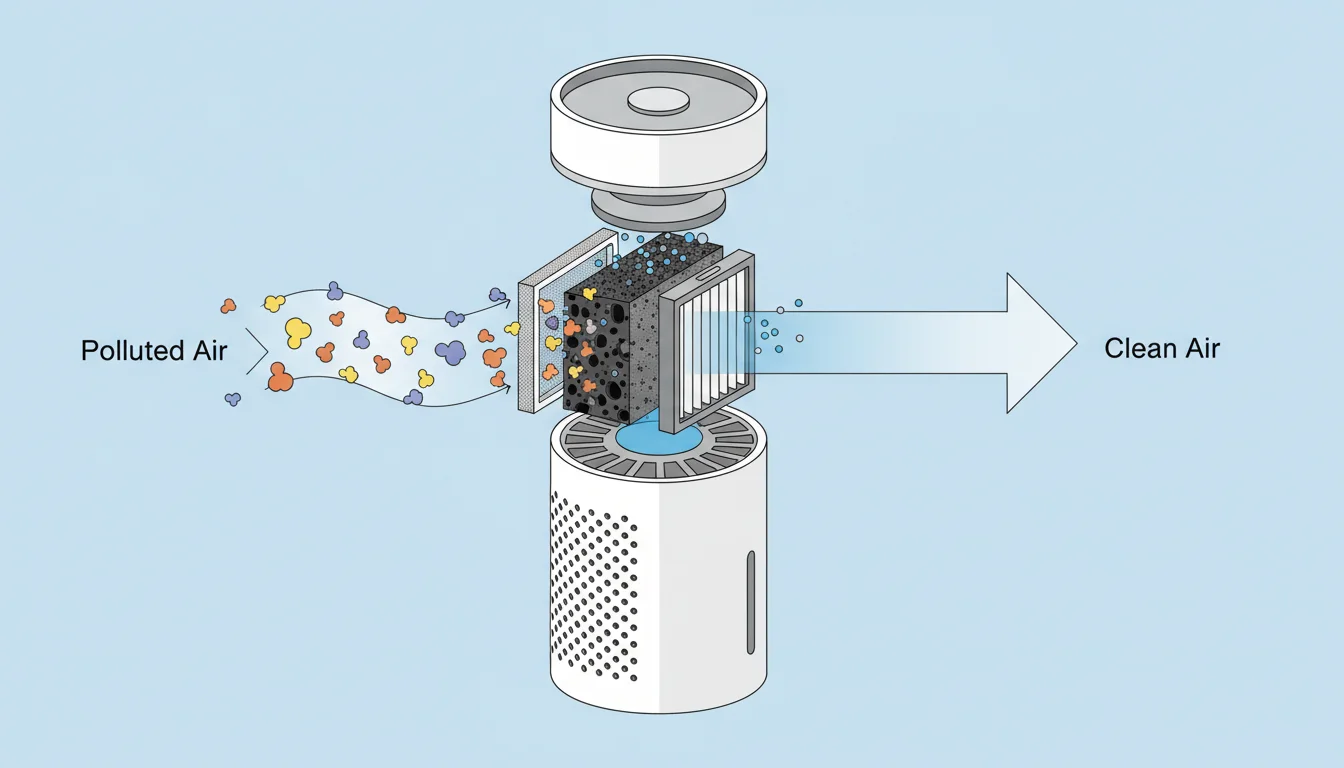
HEPA filters work brilliantly for particles. But VOCs are gas molecules far smaller than anything a HEPA filter captures—they pass straight through the fiber matrix without resistance.
Charles Weschler, an indoor pollution expert, warns that some oxidation-based air cleaners introduce chemicals more concerning than what they remove. Stick with physical adsorption methods like activated carbon for the safest approach. MIT News research confirms activated carbon remains the most reliable VOC removal technology without generating harmful byproducts.
Activated Carbon: Weight and Quality Matter
For meaningful VOC capture, your purifier needs a minimum of 3 pounds of activated carbon. Thin carbon sheets in budget units saturate within weeks and stop working entirely.
- Pelletized carbon offers more surface area than granular forms and lasts longer
- Granular carbon provides higher capacity for heavy VOCs but works best in industrial fixed-bed systems
- Treated carbons impregnated with potassium permanganate target specific VOCs like formaldehyde
- Premium units like the Austin HealthMate pack 15 pounds of carbon and zeolite for serious chemical absorption
Filter lifespan depends on your VOC load. Heavy off-gassing environments saturate carbon faster. Most quality carbon filters last 6–12 months before needing replacement.
I learned the hard way that a $30 purifier with a paper-thin carbon layer does nothing for paint fumes. The carbon saturated in two weeks. Spending more upfront on substantial carbon weight saves frustration and money over time. HouseFresh recommends checking manufacturer specs for exact carbon weight before purchasing.
Long-Term Cost of Ownership Analysis
The sticker price tells you almost nothing about what an air purifier for VOC removal actually costs over three to five years of use.
| Cost Component | Budget Unit ($200) | Mid-Range Unit ($400) | Premium Unit ($600) |
|---|---|---|---|
| Initial Purchase | $200 | $400 | $600 |
| Filter Costs (3 years) | $300 ($100/year) | $225 ($75/year) | $225 ($75/year) |
| Energy Costs (3 years) | $135 ($45/year) | $135 ($45/year) | $270 ($90/year) |
| Total 3-Year Cost | $635 | $760 | $1,095 |
Budget units look attractive until you realize their cheap carbon filters need quarterly replacement. A $200 purifier requiring $100 in annual filters catches up to premium units fast.
Energy consumption matters for devices running 24/7. Most purifiers draw between 30–90 kWh annually. Calculate your local electricity rate to estimate yearly operating costs. [Dowd HVAC] analysis shows quality filtration systems pay for themselves within 1–2 years through reduced maintenance and energy savings.
Room Size and Coverage Considerations
Match your purifier's CFM rating to your room's square footage, then consider that VOC removal requires 4–6 air changes per hour compared to 2–3 for particle filtration alone.
- Calculate room volume by multiplying length, width, and ceiling height
- Check the CADR rating and divide by room volume to estimate air changes per hour
- Position the unit near VOC sources like new furniture or freshly painted walls
- Run on higher settings when off-gassing is active, then reduce for maintenance
Multiple smaller units sometimes outperform a single large purifier for VOC removal. A unit placed directly near your new couch captures formaldehyde before it disperses throughout the room, while a central unit handles ambient levels.
Whole-house solutions through HVAC integration work well for general air quality. Portable units give you flexibility to target specific problem areas. If your VOC sources are localized, a portable air purifier for volatile organic compounds placed strategically delivers better results than whole-house filtration.
What to Look for When Buying
Start with carbon weight. Any manufacturer unwilling to disclose their carbon quantity is hiding something. Aim for three pounds minimum for a bedroom unit—more for larger spaces.
Essential specifications to verify:
- Carbon weight of 3+ pounds for meaningful VOC adsorption
- AHAM certification for quality assurance (note: CADR ratings measure particles, not gases)
- Third-party VOC testing from independent laboratories
- Noise levels under 30dB on low settings for 24/7 operation
- California CARB certification confirming no harmful ozone emissions
Skip units making vague claims about "VOC reduction" without specifics. Demand testing data showing which compounds at what concentrations. VOC air purifier effectiveness varies dramatically between formaldehyde, benzene, and other chemicals.
Fair warning: marketing departments love terms like "activated carbon technology" for units containing a tablespoon of carbon dust. Read the fine print. Check reviews from air quality testing sites. Your nose knows when carbon is working—and when you've wasted money.
FAQ
Do HEPA air purifiers remove VOCs?
No. HEPA filters capture particles 0.3 microns and larger. VOCs are gas molecules that pass through HEPA media without resistance. You need activated carbon or similar adsorption technology alongside HEPA for complete air cleaning.
How often should I replace carbon filters for VOC removal?
Replace carbon filters every 6–12 months depending on your VOC concentration. High off-gassing environments like newly renovated homes saturate carbon faster. Monitor for returning odors as an indicator of filter exhaustion.
Are ionizers effective for removing VOCs?
Ionizers show minimal effectiveness for VOC removal and pose risks. Some generate ozone as a byproduct, which reacts with VOCs to create harmful secondary pollutants. Stick with activated carbon for safe, proven VOC reduction.
What size air purifier do I need for VOC removal?
Calculate based on 4–6 air changes per hour for VOC removal. A 300-square-foot room with 8-foot ceilings needs a purifier delivering at least 160 CFM. Larger capacity handles VOC loads more effectively than minimum sizing.
Does activated carbon remove formaldehyde specifically?
Standard activated carbon adsorbs formaldehyde, but specialty-treated carbons perform better. Look for carbon impregnated with potassium permanganate or similar treatments designed specifically for formaldehyde and other aldehydes.
How do I know if my air purifier is removing VOCs?
Purchase an indoor air quality monitor that measures total VOC levels. Compare readings with the purifier running versus off. A functioning carbon filter should reduce TVOC readings within hours of operation.
Are expensive air purifiers worth it for VOC removal?
Calculate 3-year total cost including filters and energy before deciding. Premium units with 10+ pounds of carbon and longer-lasting filters often cost less over time than budget units requiring frequent filter replacement.
Share this post
Related Posts
UV Air Purifier for HVAC: Complete 2025 Guide to Cleaner Indoor Air
UV Air Purifier for HVAC: Complete 2025 Guide to Cleaner Indoor Air
Air Purifier With Window Open: Does It Work? (2025 Guide)
Air Purifier With Window Open: Does It Work? (2025 Guide)
Air Purifiers for Cigarette Smoke: What Actually Works (2025 Guide)
Air Purifiers for Cigarette Smoke: What Actually Works (2025 Guide)