Air Purifier or Dehumidifier for Mold? A Complete Decision Guide for 2025
Mold thrives in 47% to 70% of American homes, causing allergies, asthma attacks, and respiratory infections that lead to over 75,000 hospitalizations annually. Choosing between an air purifier or dehumidifier for mold depends on whether you need to eliminate symptoms or attack the root cause. This guide breaks down exactly which device fits your situation—and when you need both.
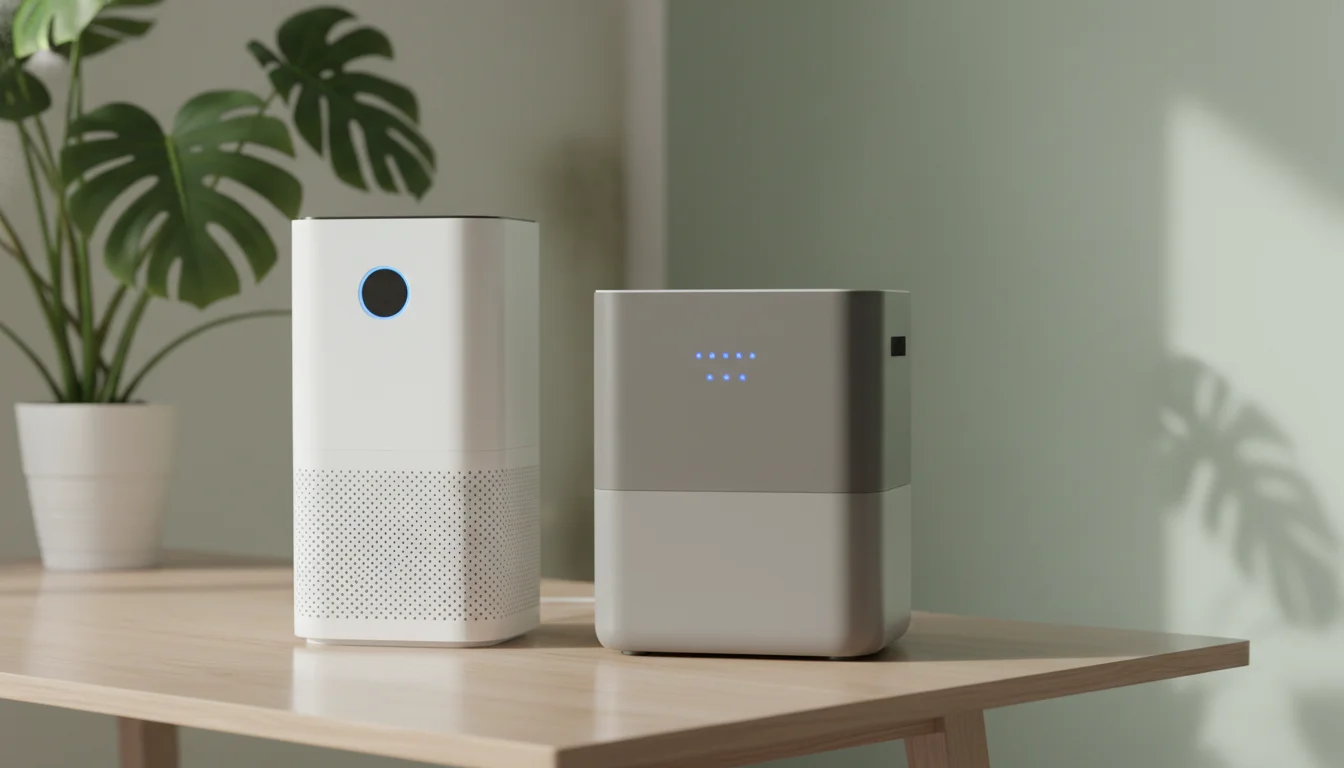
Understanding How Mold Grows in Your Home
Mold needs three things to colonize your home: moisture above 60% relative humidity, organic material to feed on, and temperatures between 40°F and 100°F. Remove any one element, and mold growth stops.
| Growth Factor | Critical Threshold | Common Sources |
|---|---|---|
| Humidity | Above 60% RH | Poor ventilation, water leaks, condensation |
| Organic Material | Any amount | Wood, drywall, carpet, fabric, dust |
| Temperature | 40–100°F | Normal indoor conditions |
| Time to Colonize | 24–48 hours | After water intrusion |
Basements, bathrooms, and kitchens top the list of problem areas. These spaces combine warmth, moisture, and organic surfaces. Crawl spaces and laundry rooms follow close behind.
Mold spreads through microscopic spores that float through your entire home via air currents and HVAC systems. About 87% of mold exposure happens indoors. The health stakes are real: 21% of American asthma cases link directly to mold and dampness exposure, according to EPA research.
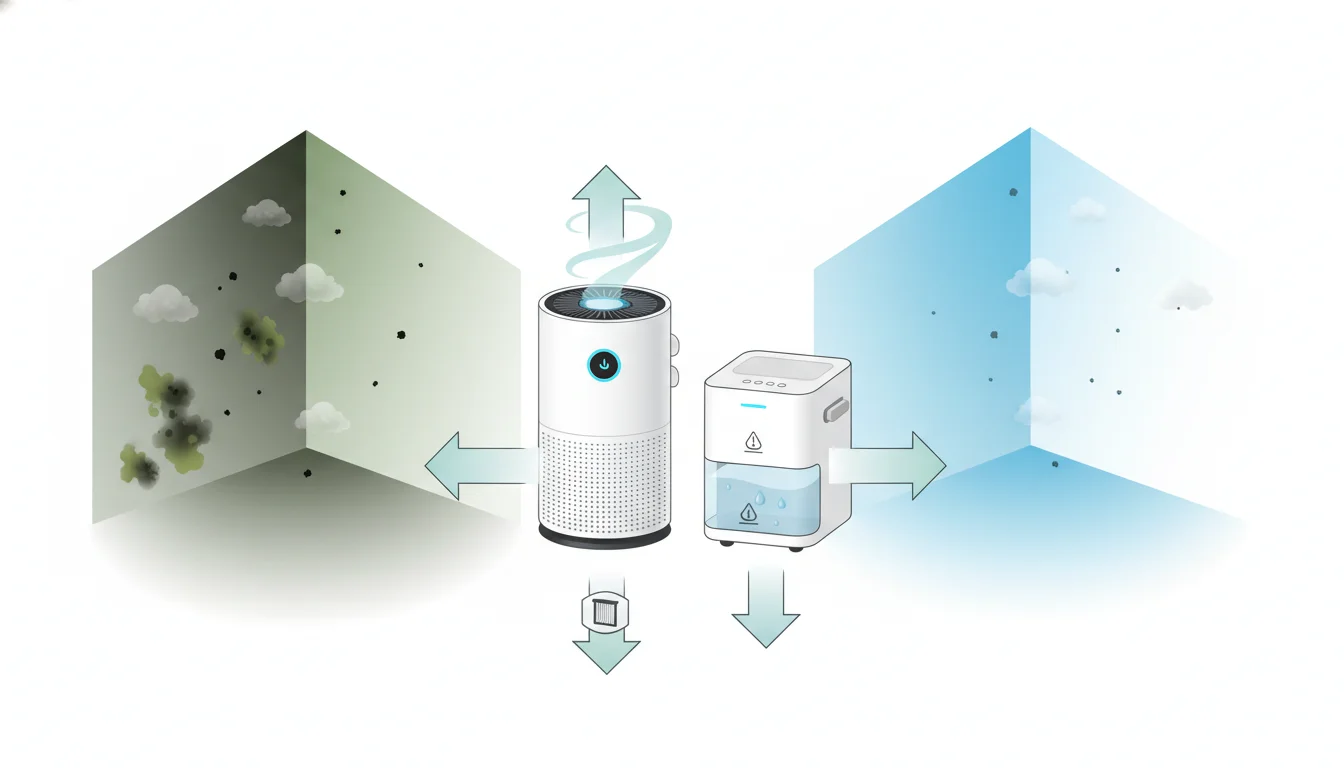
How Dehumidifiers Prevent Mold Growth
Dehumidifiers starve mold by extracting the moisture it needs to survive. They pull humid air across cold coils, condense water vapor into liquid, and release dry air back into your space.
- Target humidity range: Keep levels between 30–50% RH to stop mold growth completely
- Best locations: Basements, crawl spaces, laundry rooms, and bathrooms with poor ventilation
- Capacity guideline: 30 pints per day for every 1,000 square feet of damp space
- Refrigerant units: Work best in warm, humid conditions above 65°F
- Desiccant units: Perform better in cooler environments or when you need very low humidity
Fair warning: dehumidifiers prevent new mold but do nothing about existing colonies or airborne spores. You still need to clean visible mold or call a remediation service for serious infestations.
I learned this the hard way. Running a dehumidifier in a basement with active mold growth reduced humidity to 45%, but the musty smell persisted for weeks. The mold had already established itself on the drywall. Moisture control works for prevention, not cure.
How Air Purifiers Remove Mold Spores
HEPA air purifiers capture 99.97% of particles 0.3 microns and larger, trapping mold spores that typically measure 1–30 microns. This removes existing spores from your breathing air but does nothing to prevent new mold from growing on surfaces.
- HEPA filters: The gold standard for spore capture, physically trapping particles in dense fiber matrices
- Activated carbon: Absorbs musty mold odors and volatile organic compounds but does not capture spores
- UV-C light: Kills some microbes, but residential units lack sufficient exposure time to be reliable
- Ionizers: Charge particles to make them settle, but produce ozone as a byproduct and underperform HEPA
- Filter replacement: Every 6–12 months, or mold spores accumulate on the filter itself
Molekule confirms that HEPA filters excel at removing spores from air but emphasizes they cannot address surface mold. Achoo Allergy recommends contacting a remediation service first, then using a HEPA purifier to prevent future airborne spore problems.
Trust me on this: if you have visible mold and run an air purifier without fixing the moisture source, you're fighting an endless battle. The purifier clears spores while the mold colony keeps producing millions more.
Air Purifier vs Dehumidifier: A Side-by-Side Comparison
These devices solve different problems. A dehumidifier attacks mold at its source by removing moisture. An air purifier manages symptoms by filtering spores from your breathing air.
| Feature | Dehumidifier | Air Purifier |
|---|---|---|
| Primary Function | Removes moisture to prevent growth | Captures airborne spores |
| Approach | Addresses root cause | Treats symptoms |
| Energy Use | 300–700 watts | 30–100 watts |
| Results Timeline | Days to lower humidity | Immediate air quality improvement |
| Maintenance | Empty water tank, clean coils | Replace HEPA filter every 6–12 months |
| Annual Filter Cost | $0–30 for basic cleaning | $50–150 for HEPA replacements |
| Noise Level | 50–65 decibels | 25–55 decibels |
| Best Placement | Near moisture sources | In living and sleeping areas |
Energy costs add up differently. A dehumidifier running 12 hours daily at 500 watts costs roughly $25–30 monthly. An air purifier at 50 watts runs around $3–5 monthly on the same schedule.
The real question is what problem you're facing right now. High humidity with no visible mold? Get a dehumidifier. Controlled humidity but allergy symptoms? Get an air purifier. Both conditions? You need both devices.
When to Choose a Dehumidifier
A dehumidifier is your primary defense when moisture is the core issue. It prevents mold before colonies can establish themselves.
- Your hygrometer shows humidity consistently above 60% RH
- Condensation forms on windows, walls, or cold water pipes
- Musty smells linger in basements or enclosed storage areas
- You live in a humid climate or coastal region
- Your home has poor ventilation or recent water damage
- You want prevention before mold becomes visible
Let's be honest: if you only have budget for one device and your humidity runs high, the dehumidifier wins. It stops the problem at its source. An air purifier in a humid environment works like bailing water from a boat with holes in the hull.
When to Choose an Air Purifier
An air purifier makes sense when humidity is controlled but airborne spores still affect your health or comfort.
- Family members suffer from mold allergies or asthma triggered by spores
- Professional remediation removed mold, but you want to clear lingering spores
- Humidity stays below 50%, yet musty odors persist
- You need immediate symptom relief while addressing underlying moisture problems
- Specific rooms have poor air circulation despite low humidity
- You already have a dehumidifier handling moisture control
I found air purifiers most valuable after remediation work. The mold source was gone, but spores had spread throughout the ductwork. A HEPA purifier in the main living area cleared symptoms within 48 hours. The difference in breathing quality was noticeable the first morning.
The Best Solution: Using Both Devices Together
Pairing a dehumidifier with an air purifier creates complete protection. One prevents new growth while the other removes existing spores from your air.
| Device | Optimal Placement | Primary Goal |
|---|---|---|
| Dehumidifier | Basement, crawl space, near water sources | Keep humidity at 30–50% RH |
| Air Purifier | Bedrooms, living rooms, home office | Capture circulating spores |
| Hygrometer | Each major room | Monitor conditions |
Place dehumidifiers where moisture enters or accumulates. Position air purifiers where you spend the most time breathing. A hygrometer in each major area lets you track whether your strategy is working.
For severe mold problems, consider whole-home solutions. Some HVAC add-ons combine dehumidification and filtration. Standalone combo units exist but typically underperform dedicated devices in both functions.
Budget priority if you need to phase purchases: dehumidifier first if humidity exceeds 60%, air purifier first if you have respiratory symptoms but controlled humidity. Add the second device within three to six months for complete coverage.
FAQ
What humidity level kills mold?
Mold cannot grow below 50% relative humidity and dies back significantly below 40% RH. Keeping your home between 30–50% RH stops new growth and slowly desiccates existing colonies on non-porous surfaces.
Do air purifiers help with mold smell?
HEPA purifiers with activated carbon filters remove musty mold odors effectively. The carbon absorbs volatile organic compounds responsible for that distinctive smell. Replace carbon filters every three to six months for continued odor control.
How long does it take a dehumidifier to prevent mold?
A properly sized dehumidifier lowers humidity to safe levels within two to five days in most spaces. Mold prevention begins immediately once humidity drops below 60% RH. Maintain continuous operation during humid seasons.
Should I run an air purifier 24/7 for mold?
Continuous operation provides the best spore removal, especially in bedrooms during sleep. Modern HEPA purifiers on low settings use minimal energy and operate quietly. Run at higher speeds after disturbances like vacuuming that stir up settled spores.
Do I need professional remediation before using these devices?
Visible mold larger than 10 square feet requires professional remediation before air purifiers or dehumidifiers will solve the problem. Small patches under 10 square feet can be cleaned with detergent and water, then managed with these devices.
What size dehumidifier do I need for mold prevention?
Calculate 30 pints of daily capacity per 1,000 square feet of damp space. A 1,500-square-foot basement needs a 45–50 pint unit. Oversizing slightly ensures the unit cycles less frequently and lasts longer.
Do combo air purifier and dehumidifier units work?
Combo units compromise performance in both functions. Dedicated devices outperform combination units in head-to-head testing. If space or budget forces a choice, buy a quality dehumidifier first and add a separate air purifier later.
Share this post
Related Posts
UV Air Purifier for HVAC: Complete 2025 Guide to Cleaner Indoor Air
UV Air Purifier for HVAC: Complete 2025 Guide to Cleaner Indoor Air
Air Purifier With Window Open: Does It Work? (2025 Guide)
Air Purifier With Window Open: Does It Work? (2025 Guide)
Air Purifiers for Cigarette Smoke: What Actually Works (2025 Guide)
Air Purifiers for Cigarette Smoke: What Actually Works (2025 Guide)