Air Purifier Near Cat Litter: Complete Guide to Eliminating Litter Box Odors in 2025
Cat litter box odor stems from ammonia in urine and volatile organic compounds in feces, both of which degrade indoor air quality. Activated carbon filters remove up to 95% of ammonia odors within 40 minutes when positioned correctly. This guide covers filter selection, placement strategies, product recommendations, and safety considerations for cat owners.
How Air Purifiers Reduce Litter Box Odor
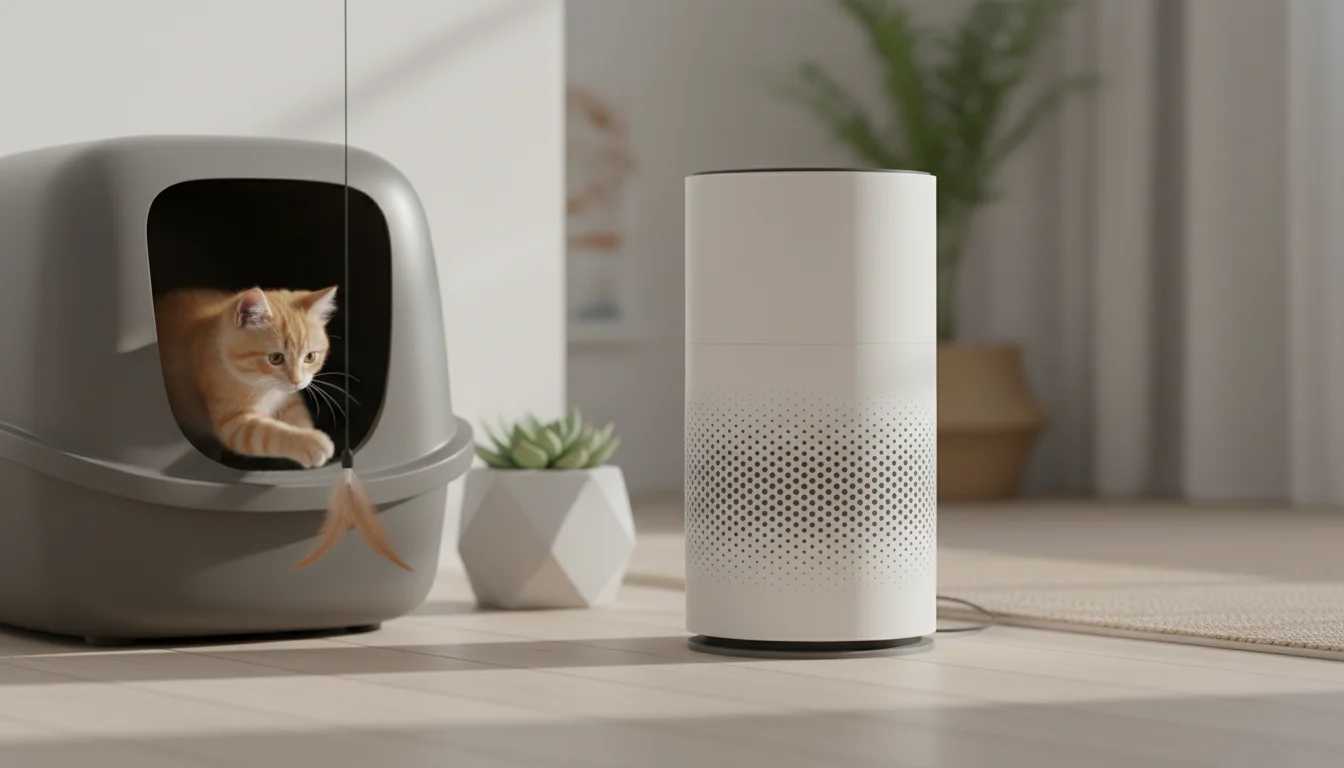
An air purifier near cat litter works through two complementary filtration stages that target both particles and gases simultaneously.
Activated carbon filters contain millions of microscopic pores that adsorb ammonia and VOCs directly from the air. These odor-causing molecules bind to the carbon surface, removing them from circulation rather than simply masking them. HEPA filters handle the physical component by capturing 99.97% of particles at 0.3 microns, including litter dust and dander that carry smell.
| Filtration Type | What It Removes | Speed of Results |
|---|---|---|
| Activated Carbon | Ammonia, VOCs, gases | 20-40 minutes for significant reduction |
| HEPA | Dust, dander, litter particles | Immediate particle capture |
| Combined System | Full odor and particle control | 24-48 hours for noticeable improvement |
Most cat owners notice a difference within 24-48 hours of continuous operation. The key is running the purifier constantly near the litter box rather than turning it on only when odors become noticeable. Testing by Coway showed their activated carbon filters remove up to 99% of fecal odors within 20 minutes.
Essential Filter Types for Cat Litter Odor Control
Two filter types are non-negotiable for litter box odor control: HEPA for particles and activated carbon for gases.
HEPA filters capture the physical matter that carries odors through your home. Litter dust, dander, and microscopic fecal particles all get trapped. Medical-grade HEPA filters catch particles as small as 0.1 microns with 99.9% efficiency.
Activated carbon handles the invisible gases that create the smell. The porous structure of carbon provides massive surface area for ammonia and VOC molecules to bind. More carbon weight means better odor absorption.
| Filter System Type | Pros | Cons | Best For |
|---|---|---|---|
| Combination (HEPA + Carbon in one unit) | Simple replacement, compact design | Limited carbon quantity | Single cat, small rooms |
| Separate Filter Systems | Larger carbon capacity, better odor control | Higher cost, more maintenance | Multi-cat homes, strong odors |
| Specialty Pet Filters | Enhanced formulations with zeolite | Premium pricing | Severe odor problems |
The [Austin Air HealthMate] uses 15 pounds of activated carbon mixed with zeolite, making it the gold standard for homes with multiple cats. Zeolite specifically targets ammonia molecules, providing extra protection against that sharp urine smell.
Optimal Air Purifier Placement Near the Litter Box
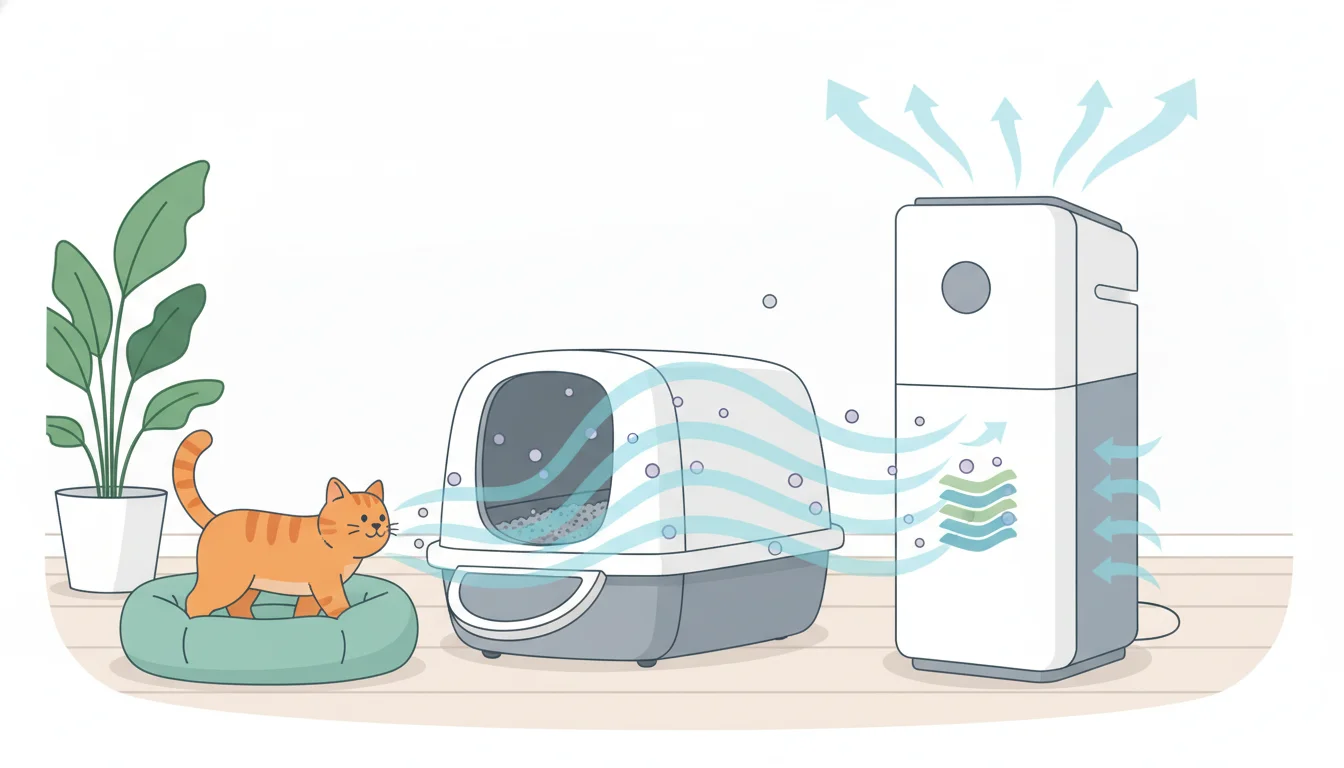
Position your air purifier 3 to 6 feet from the litter box with the intake facing directly toward the source.
This distance captures odors before they spread while avoiding disturbance to your cat. Place the unit at floor level or slightly elevated—around 3 to 5 feet high—since odor particles rise with natural air circulation.
- Point the intake side toward the litter box with no furniture blocking airflow
- Avoid corners and enclosed spaces that restrict air circulation
- Keep vents clear of curtains, plants, and pet beds
- Position away from walls, leaving at least 12 inches of clearance
Multi-cat household strategy: Calculate your room's square footage and match it to your purifier's CADR rating. A 200 sq ft room with two litter boxes needs a purifier rated for at least 250 sq ft to handle the extra load. Consider placing separate units near each litter box location rather than relying on one central unit.
The biggest mistake cat owners make is placing purifiers too far from the source. Research from Airdog confirms that proximity matters more than raw power. A smaller unit placed 4 feet away outperforms a larger unit across the room.
Top Air Purifier Recommendations for Cat Owners
Choose based on room size, carbon filter weight, and annual filter replacement costs rather than brand recognition alone.
| Category | Model | Room Coverage | Carbon Weight | Noise Level | Annual Filter Cost |
|---|---|---|---|---|---|
| Premium | Austin Air HealthMate | 1,500 sq ft | 15 lbs | 50-60 dB | $120-150 |
| Premium | Levoit EverestAir | 562 sq ft | 2.2 lbs | 24-52 dB | $80-100 |
| Mid-Range | Coway Airmega 200M | 361 sq ft | 1.1 lbs | 24-53 dB | $50-70 |
| Budget | Levoit Core 300 | 219 sq ft | 0.77 lbs | 24-50 dB | $40-50 |
| Targeted | Purrified Air Litter Box Filter | Immediate area | Proprietary | Ultra-quiet | $30-40 |
Premium options make sense for multi-cat households or large rooms. The Austin Air HealthMate's 15-pound carbon load handles even the worst odor situations. Mid-range picks like the Coway Airmega 200M balance performance with reasonable filter costs.
For budget-conscious cat owners, the [Levoit Core 300] priced under $100 performs surprisingly well in rooms under 220 square feet. The trade-off is smaller carbon filters that need more frequent replacement.
Noise matters if your litter box sits in a bedroom or living area. Look for units under 30 dB on low settings—that's quieter than a whisper.
Maintenance and Filter Replacement Guide
Carbon filters lose effectiveness after 3-6 months of continuous use near litter boxes, even if they look clean.
The porous structure of activated carbon eventually fills with trapped molecules. Once saturated, the filter stops absorbing new odors. HEPA filters last longer—typically 12 months—but litter dust shortens their lifespan.
- Carbon filters: Replace every 3-4 months with heavy use, 6 months with moderate use
- HEPA filters: Replace every 9-12 months; check monthly for visible dust buildup
- Pre-filters: Vacuum or rinse weekly to extend main filter life
- Warning signs: Reduced airflow, returning odors, visible dust accumulation
| Brand | HEPA Filter Cost | Carbon Filter Cost | Combined Annual Cost |
|---|---|---|---|
| Austin Air | $99 (5-year lifespan) | Included | ~$20/year |
| Levoit EverestAir | $79 | Included | ~$80/year |
| Coway Airmega | $49 | $29 | ~$90/year |
| Levoit Core 300 | $39 | Included | ~$50/year |
Pre-filter maintenance saves money. Vacuuming the washable pre-filter every week prevents large particles from reaching your expensive HEPA filter. This simple habit extends filter life by 20-30%.
Safety Considerations for Cats and Kittens
Avoid ionizers and ozone generators entirely—these irritate feline respiratory systems and create harmful byproducts.
Cats have sensitive lungs. Ozone, even in small amounts, causes respiratory distress. Some air purifiers market "ionizing" features as beneficial, but veterinarians recommend against them for homes with pets.
- Choose HEPA and carbon filtration only—no ionizers or UV-C lights
- Secure power cords with cord covers or tape to prevent chewing
- Place units on stable surfaces or mount them to prevent tipping
- Look for CARB (California Air Resources Board) certification
- Test on the lowest fan speed first to check your cat's reaction to noise
Sudden fan speed changes startle some cats. Smart purifiers with auto-mode detect air quality changes and ramp up quickly, which can bother noise-sensitive pets. Manual speed control gives you more predictable operation.
I learned this the hard way when my cat refused to use her litter box for a week after I installed an auto-adjusting purifier nearby. Once I switched to manual mode, the problem resolved immediately.
FAQ
Do air purifiers completely eliminate litter box smell?
Air purifiers reduce odors significantly but work best alongside regular litter box cleaning. Scoop waste daily and change litter weekly for optimal results. The purifier handles airborne odors while you handle the source.
How long should I run the air purifier near my cat's litter box?
Run it continuously, 24/7. Odor particles release constantly from the litter box, not just during use. Most quality purifiers consume less electricity than a light bulb on low settings.
Will my cat be scared of the air purifier noise?
Most cats adapt within a few days. Start on the lowest setting and gradually increase. Units under 30 dB on low settings rarely bother cats. Avoid placing the purifier directly next to the litter box if your cat seems hesitant.
Can I use scented filters or air fresheners with my purifier?
Avoid scented products near cat areas. Cats have sensitive noses, and many artificial fragrances irritate their respiratory systems. Stick with unscented activated carbon, which neutralizes odors without adding new chemicals.
How close is too close for an air purifier near a litter box?
Closer than 2 feet creates problems. Direct airflow disturbs the litter and dries it out faster. The 3-6 foot range captures odors effectively without affecting your cat's comfort or litter condition.
Do I need a separate air purifier for each litter box?
One purifier handles multiple boxes in the same room if sized correctly. For boxes in different rooms, you need separate units. A single purifier cannot pull air effectively through doorways or around corners.
Are expensive air purifiers worth it for litter box odor?
Premium models justify their cost through larger carbon loads and longer filter lifespans. A $400 Austin Air with $20 annual filter costs beats a $100 unit with $80 annual replacement expenses over five years.
What CADR rating do I need for litter box odor control?
Target a CADR rating equal to or higher than your room's square footage for adequate air changes. A 200 sq ft room needs at least 200 CADR. For strong odors or multiple cats, go 25% higher.
Share this post
Related Posts
UV Air Purifier for HVAC: Complete 2025 Guide to Cleaner Indoor Air
UV Air Purifier for HVAC: Complete 2025 Guide to Cleaner Indoor Air
Air Purifier With Window Open: Does It Work? (2025 Guide)
Air Purifier With Window Open: Does It Work? (2025 Guide)
Air Purifiers for Cigarette Smoke: What Actually Works (2025 Guide)
Air Purifiers for Cigarette Smoke: What Actually Works (2025 Guide)