Air Purifiers for Gas Stove Emissions: Complete Guide to Cleaner Kitchen Air
Gas stoves release nitrogen dioxide, carbon monoxide, and formaldehyde during cooking. According to research, children in homes with gas stoves have a 42% higher risk of asthma symptoms. This guide covers how an air purifier gas stove setup works, its limitations, and complementary solutions for cleaner kitchen air.
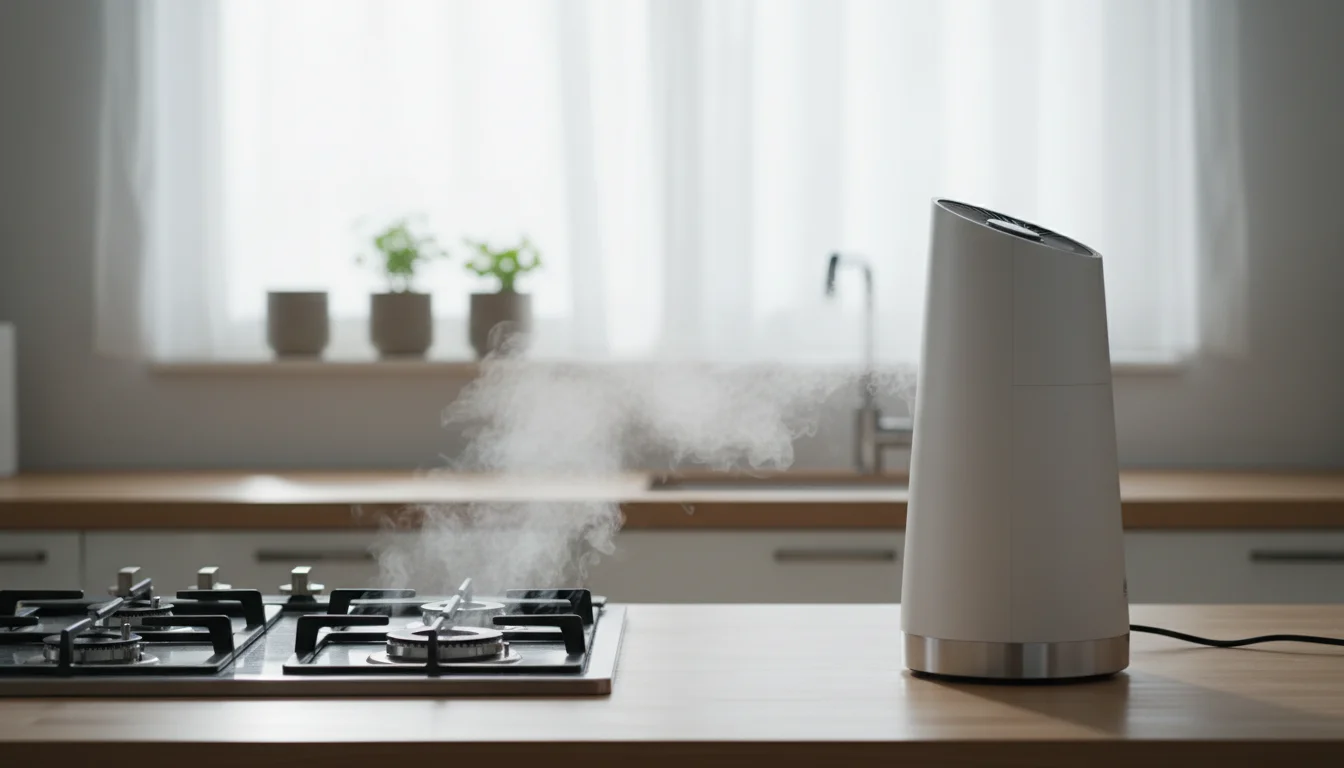
What Harmful Gases Do Gas Stoves Emit?
Gas stoves produce multiple pollutants that degrade indoor air quality within minutes of ignition.
| Pollutant | Source | Health Concern |
|---|---|---|
| Nitrogen dioxide (NO₂) | Primary combustion byproduct | Respiratory irritation, asthma triggers |
| Carbon monoxide (CO) | Incomplete combustion | Oxygen deprivation, poisoning risk |
| Formaldehyde | Released during cooking | Eye and throat irritation, carcinogen |
| Volatile organic compounds | Burning natural gas | Varied respiratory effects |
| Particulate matter (PM2.5) | Combustion and cooking fumes | Lung penetration, cardiovascular stress |
Nitrogen dioxide concentrations during cooking regularly exceed 100 parts per billion—above the EPA's one-hour outdoor air quality standard. In other words, your indoor air can become more polluted than a busy highway intersection.
The combination effect matters here. Particulate matter from frying or searing mixes with gas combustion byproducts, creating a cocktail of irritants your lungs absorb with every breath. When I measured my own kitchen while making stir-fry, the readings surprised me.
Health Risks of Gas Stove Emissions
Long-term exposure to gas stove pollution increases respiratory disease risk, particularly for children and elderly household members.
- Gas stove use accounts for approximately 12.3% of childhood asthma cases in Australia
- NO₂ exposure worsens existing respiratory conditions within hours
- Poor kitchen ventilation multiplies pollutant concentrations by 3-5x
- Children breathe faster and inhale more pollutants relative to body weight
- Elderly individuals with compromised lung function face amplified risks
Research from [NIH] shows gas stove indoor air quality degrades rapidly during cooking. Ventilation makes the difference between safe and hazardous exposure levels. Fair warning: if your kitchen lacks an exhaust hood, you're breathing the worst of it.
How Air Purifiers Work Against Gas Stove Pollution
Different filter technologies target different pollutants. HEPA alone captures particles but lets gases pass through completely.
| Filter Type | Captures Particles | Captures NO₂ | Captures Formaldehyde | Captures VOCs |
|---|---|---|---|---|
| HEPA only | Yes | No | No | No |
| Activated carbon | No | Partial | Yes | Yes |
| Zeolite | No | Yes | Partial | Partial |
| Combination system | Yes | Yes | Yes | Yes |
Activated carbon filters adsorb formaldehyde and VOCs through a chemical bonding process. Zeolite filters specifically target nitrogen dioxide molecules. Standard HEPA filter gas stove setups miss the most dangerous emissions entirely.
A randomized study found air purifiers with carbon filters reduced median NO₂ concentrations by 27% in kitchens. That reduction requires combination filtration. APHA identifies this multi-filter approach as necessary for meaningful protection. I learned this the hard way after running a HEPA-only unit for months, thinking I was covered.
Limitations of Air Purifiers for Gas Stoves
Air purifiers supplement ventilation but cannot replace it. Several constraints affect their kitchen performance.
- Carbon monoxide passes through all consumer air purifier filters. You need dedicated CO detectors for safety.
- NO₂ spikes during active cooking overwhelm filter capacity. Peak concentrations exceed what carbon and zeolite filters can handle in real time.
- Kitchen grease and cooking fumes degrade filters faster than bedroom or living room use. Expect 40-60% shorter filter life.
- Room size determines effectiveness. A unit rated for 200 square feet won't adequately protect a 400-square-foot open kitchen.
- CADR ratings indicate air cleaning speed. Low-CADR units cycle air too slowly during intense cooking.
Does an air purifier help with a gas stove? Yes, but with caveats. According to [EMG HVAC], purifiers reduce exposure to particulates and some gases while working alongside proper ventilation. They're part of the solution, not the whole answer.
Best Practices: Placement and Sizing for Kitchen Air Purifiers
Position your purifier 3-6 feet from the stove. Closer placement interferes with cooking airflow, while farther distances reduce capture efficiency.
- Select a unit rated for 1.5x your kitchen's square footage. Oversizing compensates for high pollutant loads.
- Run on high speed during cooking and for 30 minutes afterward. Normal mode won't keep pace with emission rates.
- Choose models with auto-sensing that detect air quality changes. They ramp up automatically when cooking starts.
- Keep air intake vents unobstructed. Grease splatter zones need at least 2 feet of clearance.
- For renters without exhaust hoods, a properly sized purifier becomes your primary defense.
The best air purifier for gas stove emissions combines high CADR with multi-stage filtration. Budget units with thin carbon layers won't cut it. Look for at least 2 pounds of activated carbon in the filter assembly.
Complementary Solutions: Range Hoods and Ventilation
Range hoods with external venting remove 50-80% of cooking emissions at the source. No air purifier matches that capture rate.
| Solution | Effectiveness | Cost | Best For |
|---|---|---|---|
| External-venting range hood | 50-80% pollutant removal | $200-800 + installation | Homeowners, heavy cooking |
| Recirculating range hood | 20-40% removal | $100-400 | Renters, light cooking |
| Open windows (cross-ventilation) | 30-50% removal | Free | Mild weather, supplemental |
| Air purifier with carbon/zeolite | 20-30% removal | $150-600 | Residual pollutants, continuous |
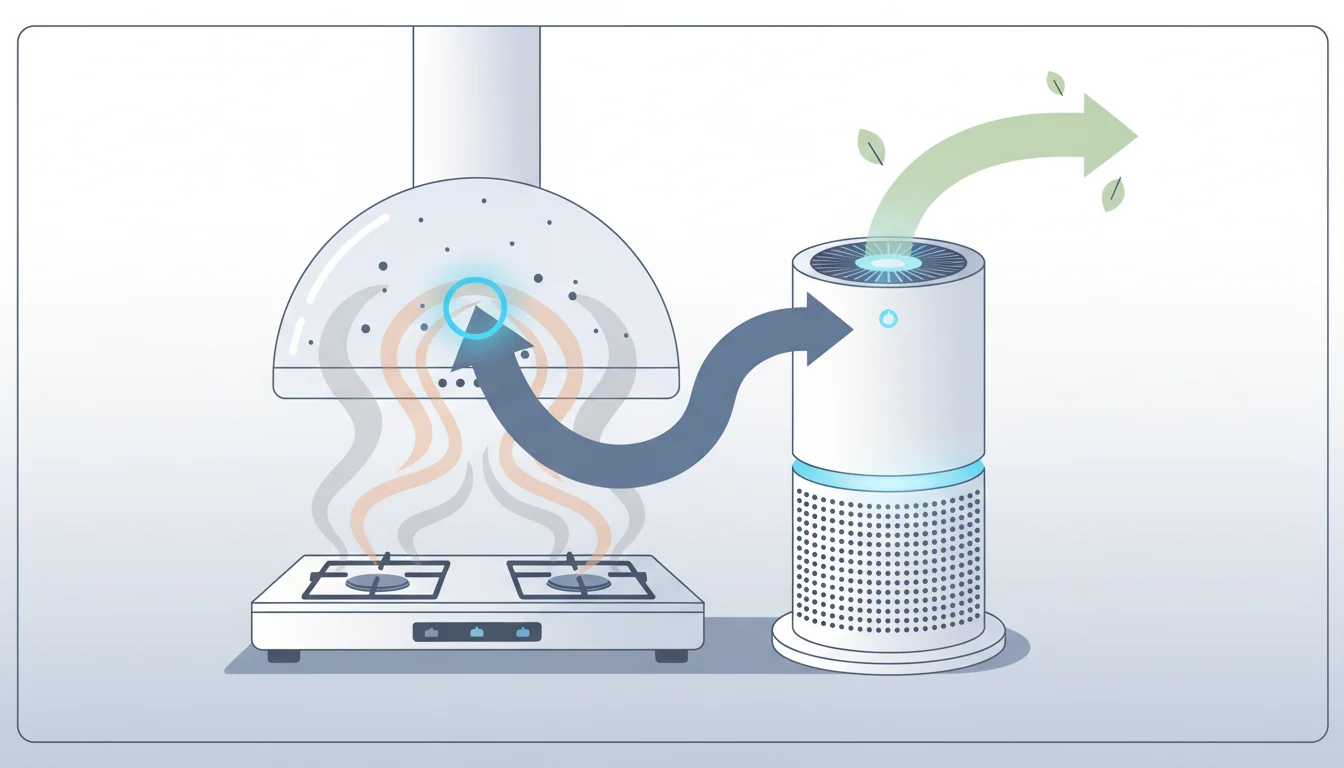
The combination approach works best. Run your range hood during cooking to capture emissions at the source, then keep the air purifier running for residual gas stove pollution that escapes the hood.
[Coway UK] emphasizes this layered strategy. Opening windows on opposite sides of your kitchen creates cross-ventilation that dilutes pollutant concentrations. I noticed a dramatic difference in my own kitchen after installing a 600 CFM hood and adding a carbon-filter purifier. The air smells cleaner within minutes of turning off the burners.
FAQ
Do HEPA air purifiers remove nitrogen dioxide from gas stoves?
No. HEPA filters capture particulate matter only. Nitrogen dioxide passes through HEPA media unchanged. You need activated carbon or zeolite filtration to reduce NO₂ concentrations in your kitchen air.
How often should I replace air purifier filters in my kitchen?
Kitchen environments require filter replacement every 3-4 months instead of the standard 6-12 months. Cooking grease and high pollutant loads degrade filter media faster than typical residential use.
Can an air purifier detect carbon monoxide from my gas stove?
Air purifiers do not detect or filter carbon monoxide. Install dedicated CO detectors in your kitchen for safety. This is non-negotiable for any home with gas appliances.
Should I run my air purifier while cooking or only afterward?
Run it during cooking on high speed and continue for 30 minutes after. Starting before you cook creates a clean baseline. Continuing afterward captures lingering gases and particles.
Is replacing my gas stove better than using an air purifier?
Studies show switching to electric or induction reduces indoor NO₂ by over 50%. This exceeds what any air purifier achieves. If health is your priority and replacement is feasible, induction outperforms filtration solutions.
What CADR rating do I need for kitchen air purification?
Target a CADR of at least 200 CFM for average kitchens under 200 square feet. Larger or open-concept kitchens need 300+ CFM. Higher CADR means faster air cycling during heavy cooking.
Do recirculating range hoods help with gas stove emissions?
Recirculating hoods filter some particles but vent nothing outdoors. They reduce pollutants by 20-40% compared to 50-80% for externally vented hoods. They're better than nothing but less effective than ducted exhaust.
Share this post
Related Posts
UV Air Purifier for HVAC: Complete 2025 Guide to Cleaner Indoor Air
UV Air Purifier for HVAC: Complete 2025 Guide to Cleaner Indoor Air
Air Purifier With Window Open: Does It Work? (2025 Guide)
Air Purifier With Window Open: Does It Work? (2025 Guide)
Air Purifiers for Cigarette Smoke: What Actually Works (2025 Guide)
Air Purifiers for Cigarette Smoke: What Actually Works (2025 Guide)